

Table of Contents
Geometry art provides a unique lens to understand the world, combining precision, pattern, and structure to explore both aesthetic and ecological ideas. In his latest series, The Planet is Screaming, Listen to Mother Earth, South African artist Pierre Louis Geldenhuys uses folded silk, light, and geometric principles to investigate humanity’s relationship with the natural world. Debuted at the 2026 Investec Cape Town Art Fair, the series demonstrates how contemporary art can educate, inspire, and provoke reflection on environmental fragility and regeneration.
The Timeless Language of Geometry Art
Geometry art has endured across cultures and centuries, from ancient architecture and sacred patterns to modern design and digital systems. Its lasting relevance lies in its ability to translate complex ideas into visual order, using repetition, symmetry and proportion to create meaning beyond decoration. Geometry offers a universal language that transcends time and geography, allowing artists to explore concepts of harmony, balance and interconnectedness that remain deeply resonant in contemporary society.
In a modern context, geometric art continues to evolve as a tool for reflection and education. It provides a framework through which abstract ideas, such as environmental systems, human impact, and natural cycles, can be visually interpreted. By returning to geometric principles, contemporary artists draw on a visual tradition that is both ancient and future-facing, demonstrating how timeless structures can be used to address present-day concerns with clarity and depth.
1. Listening to the Earth
This series encourages viewers to pause and observe the world around them, revealing both its vulnerability and resilience. By transforming attention into reflection, the work positions art as a tool for understanding the complex ecological systems and the subtle signals they convey. Rather than presenting environmental issues through urgency or alarm, the series invites a quieter form of engagement, one rooted in awareness, observation, and responsibility.
2. Geometry as a Visual Language
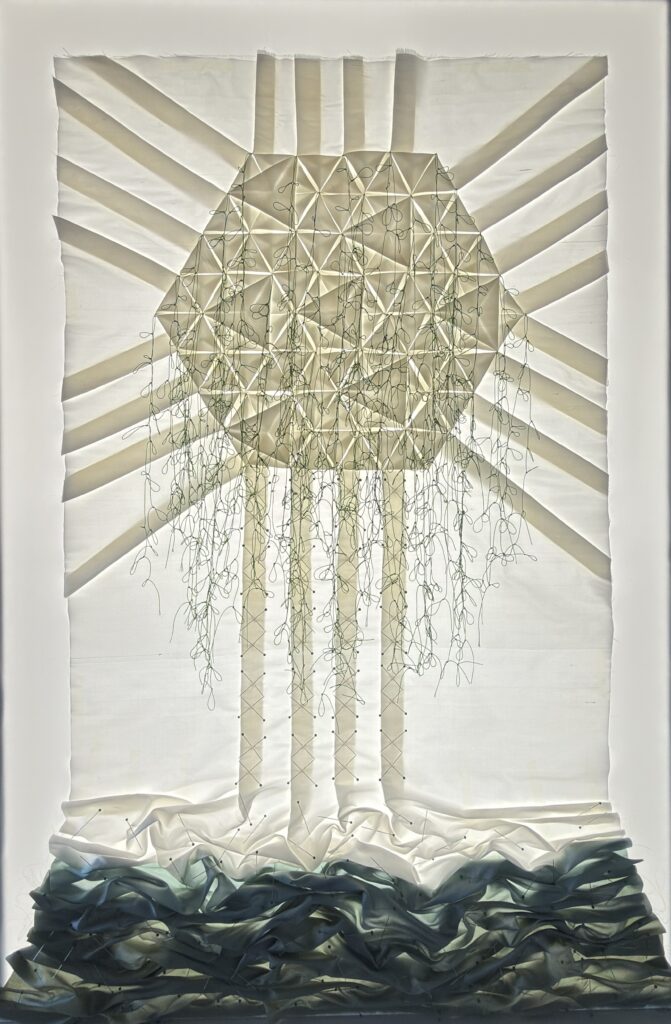
Geldenhuys’s practice spans theatre, fashion, geometry, and textile abstraction. Drawing on Islamic tessellation, symmetry, and repetition, his work illustrates how structured patterns can mirror natural order and interconnected systems. Geometry becomes more than a formal device. It functions as a conceptual framework through which ideas of balance, fragility, and interdependence are explored. In this way, mathematical structure becomes a visual language for understanding the rhythms of the natural world.

3. Silk as Medium and Metaphor
At the centre of the series is raw silk, a material chosen for both its delicacy and symbolic value. Each piece begins as a single uncut sheet, carefully folded to produce intricate, near infinite forms. Freely falling threads introduce movement and unpredictability, while illuminated light boxes give the silk an X-ray quality, revealing depth and layered complexity. The material itself becomes a metaphor for continuity, vulnerability, and the fine balance that exists within natural ecosystems.
4. The Vine as a Metaphor for Renewal
The life cycle of the vine provides a key ecological reference within the series. In viticulture, pruning is guided by close observation of the plant, including the direction of shoots, the history in its scars, and the flow of sap. Geldenhuys draws on this process to reflect on the Earth’s own cycles of damage and recovery. The vine becomes a symbol of regeneration, suggesting that renewal is possible when care, restraint, and attentiveness guide human interaction with the environment.


5. Art as an Invitation to Observe
Rather than offering warnings or solutions, the series extends an invitation to observe and reflect. Hundreds of metres of silk thread trace patterns resembling topographies, rivers, roots, and fault lines. These visual references echo natural systems that are continuously shaped by external pressures yet remain adaptable and alive. Through this, the work educates viewers about patterns of growth, movement, and repair, highlighting the role of attention and responsibility in shaping a more conscious future.
About the Artist

Pierre Louis Geldenhuys blends geometry, textiles, and light to create work that is both visually refined and intellectually rigorous. His practice explores the relationship between structure and organic imperfection, encouraging viewers to consider how material processes and spatial form can deepen understanding of humanity’s connection to the natural world.


Related Articles
![The Freak [S Howlite] sets Ulysse Nardin's flying carousel above natural howlite, so every one of the 15 pieces is unique.](https://prestigedigital.net/wp-content/uploads/2026/10/2513-500LE-9A-HOW_3A-Side-2-HD-300x225.jpg "Ulysse Nardin Sets the Freak in Stone: 15 Watches for 180 Years 8")
Ulysse Nardin Sets the Freak in Stone: 15 Watches for 180 Years
The Freak first appeared in 2001 and changed modern watchmaking.…
Sandringham Private Game Reserve and the Sixteen: The Making of Africa’s Next Master Trackers
At Sandringham Private Game Reserve, the newest property in the…
Moët & Chandon and the Art of the Occasion: Champagne Day Comes to South Africa
From Friday 23 to Sunday 25 October, Moët & Chandon…

