A new Commonwealth AI readiness index places South Africa 13th of 56 nations and second on the continent, with a possible US$9.18 billion lift to GDP within a decade. Beneath the headline score sits a sharper story about a generation keen to use the technology but still waiting for the jobs, businesses and skills that would let it pay off. For anyone with a stake in South Africa’s economy, the gap between readiness and reward is the part worth watching.
A Score That Opens a Conversation
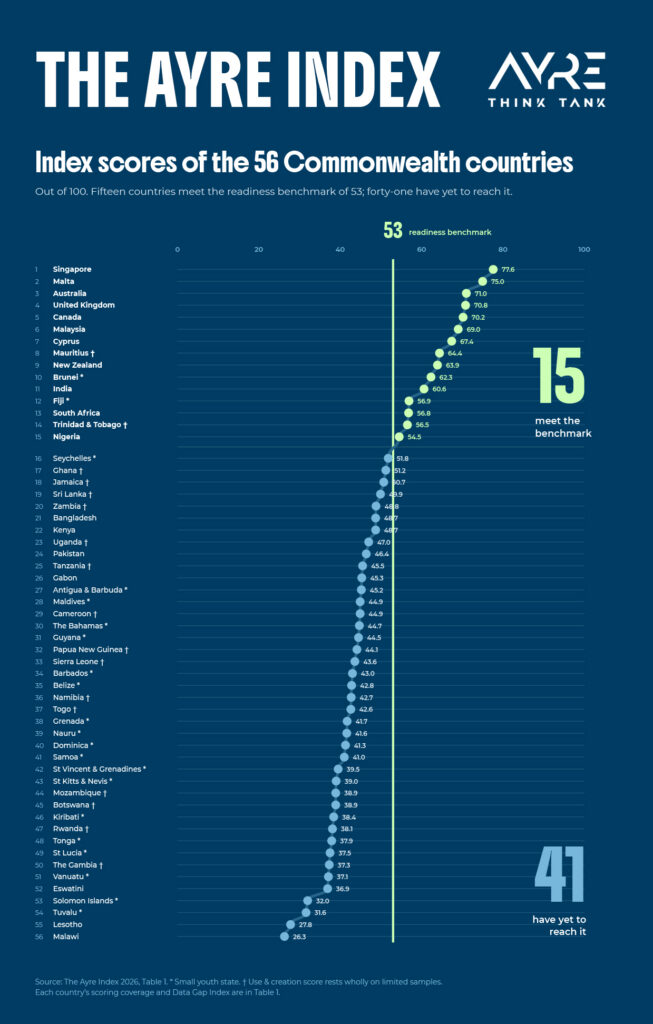
South Africa arrived at the Commonwealth Heads of Government Meeting in Antigua and Barbuda with a result worth noting. The Ayre Index, the AI readiness index launched in St John’s on 5 November 2026, gives the country a score of 56.8 out of 100. That clears the study’s youth readiness benchmark of 53, a mark only 15 of the 56 Commonwealth countries reach or pass.
On the continent, only Mauritius ranks higher, in eighth place. South Africa finishes ahead of 43 Commonwealth nations. The Index was produced by the Ayre Think Tank, founded by Antiguan Canadian philanthropist Calvin Ayre. It draws on 1,128 research sources to assess the conditions that could help some 732 million people aged 15 to 29 benefit from artificial intelligence.
An Appetite Already in Place
Interest is not the problem. In the evidence the researchers examined, 88.2% of young South African respondents expected to use AI for education or work within the following year, and around half said they already used it for study.
Entrepreneurs share the enthusiasm. In a separate survey of people aged 18 to 64 starting or running new businesses, 49.2% of South African respondents expected AI tools to be very important to their operations over the next three years. That was the highest proportion among the five Commonwealth countries with comparable findings.
The Arithmetic of Opportunity
The economic case is substantial. South Africa has roughly 16 million young people aged 15 to 29. Applying ten year economic scenarios developed by the International Monetary Fund, the researchers calculate that AI could raise the level of the country’s GDP by US$9.184 billion under a moderate scenario. The conservative case puts the figure at US$4.699 billion. The optimistic case reaches US$13.670 billion.
Those numbers carry weight because of what sits beside them. The research records unemployment among 46.3% of young South Africans in the labour force, and 39.6% of young people outside employment, education and training.
Enterprise Born of Necessity
The most telling figures concern young founders. Among South Africans aged 18 to 29 who were starting businesses, 90.9% said a shortage of jobs was one of their reasons. That is the highest proportion among seven Commonwealth countries with comparable data. Yet only 0.8% of young people in that age group owned an established business.
The distance between those two numbers explains much of the challenge. Plenty of young South Africans are willing to build something of their own. Far fewer get a venture to the point where it lasts, employs others and produces a steady income.
Trust, but Verify
The study also points to a skills gap that sounds familiar to anyone who uses these tools daily. In research conducted in 2024 and 2025, 63% of employed South African adults surveyed admitted relying on information produced by AI without checking whether it was accurate. The survey did not look specifically at young people, but it makes the case for practical skills that teach users to question the technology rather than simply accept its answers.
Calvin Ayre framed the stakes plainly. “I’ve spent my life in businesses where new technology changes everything, and I know you can’t stand still,” he said. “AI is going to change how we work, how we do business and how wealth is created. But this is not a race that only the biggest or richest countries can win. What matters is giving young people the skills and the chance to get ahead, whether to start businesses, find jobs or build something for themselves.”

He was equally direct about complacency. “Some Commonwealth countries are ahead, others have catching up to do. Nobody can afford to be complacent. That’s why we created this Index. It shows countries where they stand, what they’re getting right and where they need to do better. Governments now have to decide what they’re going to do about it.”
Partnerships Already Under Way
Some of that work has started. In March 2026, the Department of Higher Education and Training signed an agreement with Google to provide an initial 10,000 scholarships for professional qualifications in areas including AI, cybersecurity and data analysis. The programme targets students and educators at public universities and training colleges, with particular attention to rural and township communities.
Microsoft and the Youth Employment Service are also building practical AI and digital skills among young South Africans. In May 2026, the organisations reported that more than 70,000 young people had taken part in their digital learning programmes.
Five Priorities for What Comes Next
The accompanying White Paper sets out five priorities: affordable and reliable access to technology, education that builds practical skills, stronger routes from training into employment and enterprise, AI tools suited to local languages and needs, and safeguards that let young people question automated decisions. It urges governments, educators and development partners to understand the particular barriers young people face in each country before deciding where investment will do the most good.
Professor C. Justin Robinson, Pro Vice Chancellor and Campus Principal of the University of the West Indies, Five Islands Campus, put the question of ownership at the centre. “We need to make sure that the next generation will be able to do more than just consume AI products made elsewhere,” he said. “Access must come with its own agency and a real equitable stake in how these systems are governed. Young people should be equipped to question these new tools, to improve them and to be supported in building alternatives suited to their own needs.”
The Distance Between Readiness and Reward
A ranking of 13th tells South Africa where it stands, not where it is headed. The country already has the appetite, the institutional partners and a sizeable economic prize in view. What it lacks is a dependable path from a curious 20 year old with a laptop to a founder with a payroll. The Index makes the cost of standing still measurable, and as Professor Robinson observed, whether readiness becomes reward “will depend on choices made now.”


Related Articles

Nespresso and Swarovski Make a Case for the Festive Cup
The Nespresso Swarovski festive collection brings two very different crafts…
The Bow That Took 140 Years: Moët & Chandon Reimagines Its Signature for the Season of Giving
In 1886, Moët & Chandon tied a black ribbon around…
Heineken House F1 Edition Makes the Case for Watching Formula 1 Together
Heineken House F1 Edition brought invited guests together in Johannesburg…