Porsche has unveiled the Mission S, a vision model that previews the brand’s next design language and confirms a permanent mid engine super sports car platform positioned above the 911. Its most radical idea may be what it leaves out. In an era of ever larger screens, Porsche has built a concept around the driver, the road and very little else.
A Pier in Queens, and a Point Being Made
Porsche chose its stage carefully. The Mission S made its world premiere on a pier in Queens, New York, with the Manhattan skyline across the water, the same spot where the 550 Spyder was photographed in 1953. Those images travelled the world and helped make Porsche a name in America. The 550 was the brand’s first super sports car, and many still regard it as the car that defined what Porsche would become.
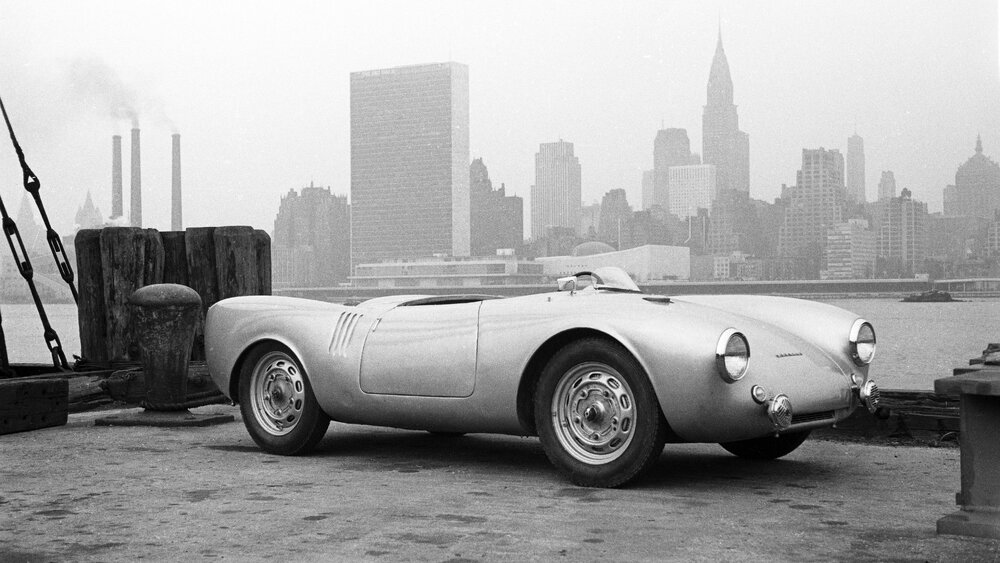
Returning to that pier is not nostalgia for its own sake. The Mission S is the first public expression of Sportwagenschmiede ’35, Porsche’s strategic realignment, and it arrives with an unusually clear brief. “A Porsche must be recognisable as a Porsche at first glance,” said Dr Michael Leiters, Chairman of the Executive Board of Porsche AG. “The Mission S provides a glimpse of the ideas and design features that will shape Porsche in the coming years.”
The more significant news sits in his second statement. The car represents “a mid engined super sports car platform positioned above the 911, not as a one off hypercar, but as a permanent and versatile addition to our customer offering.” For the first time, Porsche intends to offer a super sports car as a standing part of its line up rather than a limited run collectors’ piece.

Three Words, Applied Rigorously
Authentic, consequent and timeless. Those are the terms Porsche has set as the framework for its design identity, and the Mission S applies them with discipline. “The Mission S is the result of a forward looking, holistic design strategy,” said Tobias Sühlmann, Head of Style Porsche. “This vision model illustrates a fundamental strategic direction that we will soon be translating into our future product portfolio.”
That final clause matters. A vision model is often a styling exercise that disappears into a museum. Porsche is signalling that what you see here will filter into the cars it actually sells.
A Family History Written in Metal
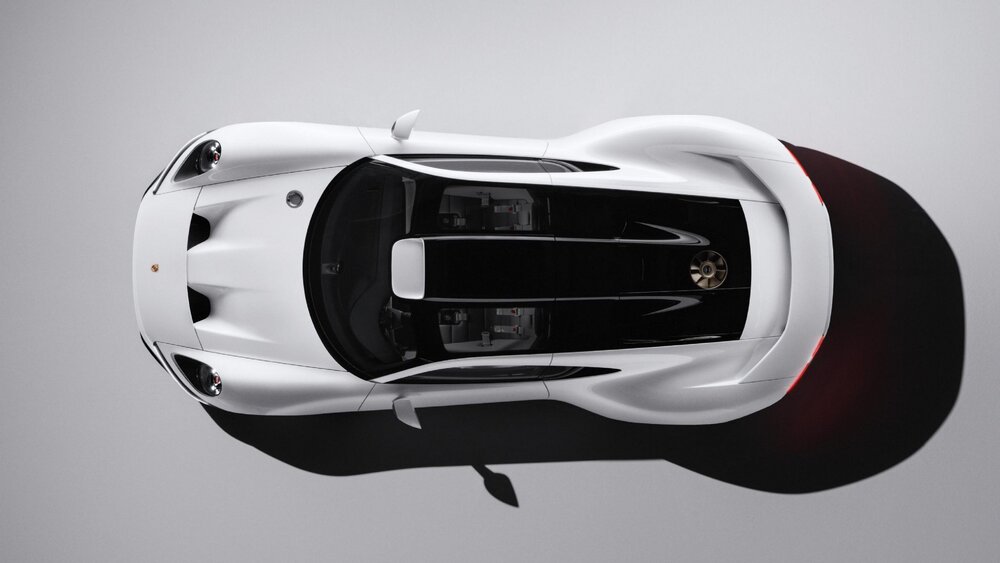
The exterior reads like an edited archive. The torpedo fenders and round headlights recall the 911. Shut lines that run into the light graphics nod to the G model. The flat front takes its cue from the GT1, and the roofline beneath the rear wing echoes the 959, here extended all the way to the tail. At the rear, a car in car concept borrowed from the GT1 completes the picture.
What keeps this from becoming a greatest hits compilation is the restraint of the line work. A single wraparound line connects the front and rear light signatures. Above it, the surfaces carry the muscle. Below it, the technical functions are left visible, a deliberate expression of lightweight construction. Porsche’s designers call the effect “floating volumes”: forms that appear to hover rather than sit.
The mid engine layout gives the car its proportions and allows the familiar Porsche flyline. Function and form meet in details such as a cooling solution that recalls the radiator fan of the 917 and a fully integrated active rear wing. Even the wheels carry lineage, reworking the dial design of the 928 into a concept geared towards lightweight construction.
Sitting Deep Within the Car
Inside, Porsche has looked further back still, to the 550 Spyder and the 356. Two lines run through the dashboard and doors, giving the occupant the sense of sitting low and enclosed within the car, and tying the cabin visually to the bodywork.
The colours draw on Porsche’s racing past. White, grey and red tones are reinterpreted through specially developed finishes: Firn White Metallic, Light Red Metallic, Black Chrome and, inside, Special Black. The seats carry the same thinking, with a seatbelt buckle integrated into the centre panel and electric adjustment controls repositioned for a cleaner, more motorsport inspired layout.


The Screen That Isn’t There
The boldest decision in the Mission S concerns the dashboard. There is no permanently integrated central display and no fixed passenger screen. Instead, a retractable smartphone holder compatible with MagSafe lets the owner’s own phone serve as a navigation or information display when needed, and disappear when it isn’t.
Everything else is organised along what Porsche calls the driver’s axis. Five round instruments sit behind the steering wheel, with the rev counter at the centre combining an analogue needle and a display behind it. Depending on the drive mode, the rev counter moves closer to the driver, and the instruments rearrange themselves, either side by side or stacked one behind another. The key holder remains to the left of the wheel, as Porsche tradition demands. New dashboard controls with a push and pull action give direct access to comfort and driving functions, and a reimagined Sport Chrono element pairs analogue character with digital precision.
The My Porsche App handles the rest, including the option to dress the circular instruments in digitally rendered designs inspired by the brand’s history. It is a quiet admission that the phone in your pocket already does most of what a car screen does, and that the car’s job is to let you drive.
Why Restraint Is the Real Luxury
For years, the measure of a modern performance car has been the size of its screens and the length of its feature list. The Mission S argues the opposite. Its premise is that the most valuable thing a sports car can offer is focus, and that heritage, used carefully, is a design tool rather than a marketing device.
For South African collectors and enthusiasts, many of whom know the 911’s lineage intimately, that argument will land. This is a brand speaking to drivers who value provenance and engagement over novelty, and the promise of a permanent super sports car above the 911 opens a new tier in the Porsche hierarchy that buyers here will be watching closely.
Back to the Pier, Forward to the Road
Porsche has not yet said what will power its new flagship, nor when it will arrive. What it has made clear is the philosophy the car will carry. Seventy three years after the 550 Spyder was photographed on that same pier, Porsche has returned with a car that looks back in order to move forward, and that treats the act of driving as the point rather than the backdrop. In a market crowded with spectacle, that clarity may prove the Mission S’s most enduring feature.


Related Articles

Moët & Chandon and the Art of the Occasion: Champagne Day Comes to South Africa
From Friday 23 to Sunday 25 October, Moët & Chandon…
Weylandts Pulls Up a Chair at The With, Its First Bar, for Design Week
For more than sixty years, Weylandts furniture has lived in…
Singularity South Africa Summit 2026: Where Innovation Meets Africa’s Next Chapter
The future rarely arrives with a warning. More often, it…